


What’s the point of making money? Almost everyone in our society is obsessed with doing so, but few question why.
I’m not disputing that financial success is a critical part of life, but the underlying psychology most people have towards it is a recipe for misery.
Let’s take a look at some common psychological approaches to money:
Many people constantly chase more money without any sense of what is enough, mostly because that is what they have been conditioned to do. “More, more, more” is an unwinnable game.
Another trap is comparison to others. I once had a client who said he wouldn’t be satisfied without $100M because that’s what his uncle was worth. I’ve also heard someone worth $100M say that sometimes he feels poor because he has friends who are richer than he is. The problem with comparison is that, unless you’re the wealthiest person in the world, there will always be someone with more money… which means the game is almost unwinnable.
The vast majority of people use spending money as an attempt to cope with or distract from emotional pain or a sense of emptiness. They do the same with public displays of wealth to impress others. Unfortunately, no luxury watch, new sports car, impressive house, or exotic vacation posted on social media is actually going to solve those deeper issues. Once again, there isn’t a winning outcome.
If you take all these unwinnable mindsets away, then what’s the point of making money? I propose an answer of an entirely different nature:
The point of making money is to allow you to lead a fulfilling and reasonably comfortable life without worrying about money.
Exactly what that looks like will differ for each person, and below I’ll walk you through how to turn that into a specific target for yourself.
However, the key point here is that we are looking to determine a threshold at which there can be a psychological transition to having “enough” so that you can focus on other aspects of life that will ultimately provide deeper fulfillment.
As discussed in the Basic Model of Problem-Solving, it’s important to set a target that is specifically defined. In the case of financial success, there’s no excuse for it not to be numerically measurable.
So how should we think about setting a target? Let’s start by looking at a model that breaks down financial success into 5 different categories:
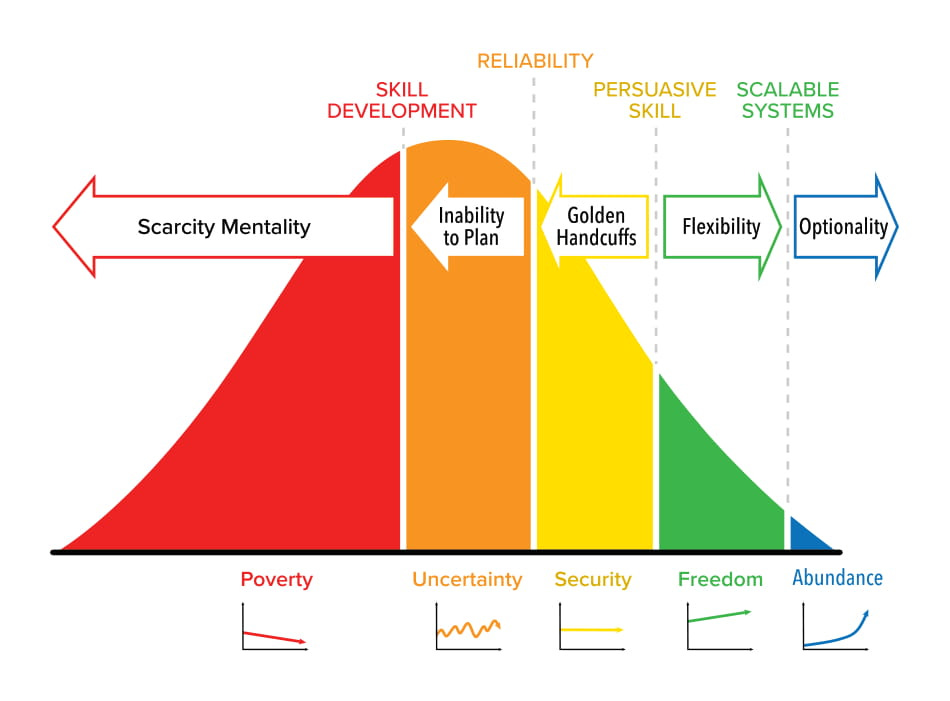
Financial Poverty (Red Zone)—In this bucket, someone is struggling to pay their bills or earn a significant income, normally due to the lack of a specialized and profitable skill. People in this category are often accumulating debt (either financial or social), and they are almost always seeing an erosion of their future earning power compared to what it could be. Because of the mounting burden of debt, people in this bucket often see a steady decline in their quality of life.
The primary force people in this bucket experience is a scarcity mentality, which saps their energy and willpower to spend time on self-development.
As mentioned above, the key to moving to the next bucket is to develop a valuable skill, which almost always requires investing time and often some amount of money to learn that skill.Financial Uncertainty (Orange Zone)—In this bucket, someone is able to cover their expenses for some temporary period of time, but the current situation is unsustainable or uncertain long-term. Perhaps they’re drawing down their savings, perhaps they don’t have confidence that their job is secure, or perhaps their income is just volatile (e.g., many solopreneurs). Either way, they’re not in immediate scarcity, but they also don’t have long-term financial security, which is reflected in an oscillating quality of life.
The primary force people in this bucket experience is an inability to plan, which holds them back by requiring them to hoard resources for a rainy day that could otherwise be used to generate a return.
The key to moving to the next bucket is reliability. For independent income earners, that reliability takes the form of discipline — in other words, being reliable in your commitments to yourself. For people working for someone else, that reliability takes the form of dependably showing up, consistently producing good work, and doing so without causing or getting embroiled in conflicts.Financial Security (Yellow Zone)—In this bucket, someone has a consistent income that allows them to pay their bills as well as build some savings and make some investments, but that income is fixed at a particular level (e.g., their salary), which is reflected in a stagnant and flat quality of life. In this bucket, it’s not possible to trade more time for more money at will. As such, this would also include a retiree drawing down their savings on a fixed budget.
The primary force people experience here is something called “golden handcuffs,” which keeps them chained to a situation that isn’t providing them with what they truly want out of life.
The key to moving to the next bucket is to develop your persuasive skills so that you aren’t dependent on an employer to bring you work and so that you can generate your own source of income independently.Financial Freedom (Green Zone)—In this bucket, someone has the ability to put in more effort to earn more money whenever they want to. This gives them the freedom to make above-normal investments as long as they work some more to bring in the extra cash. One effect of that capability is that people become acutely aware of the value of their time, which means that they start using it more efficiently, which results in a steady increase in their quality of life.
The big benefit of Financial Freedom is flexibility. Do you want to make an investment in some personal development? Take a once-in-a-lifetime trip that will create epic memories? That’s all available to you on your own timeline; all you have to do is put in the extra work.
The key to moving to the next bucket is scalable systems that allow you to deliver more value to more people without necessarily spending extra time to do so.Financial Abundance (Blue Zone)—In this bucket, time is disconnected from money. Someone’s income is based on how much their company sells or how much their investments return, rather than how many hours they put in at a given rate. More money is coming in from investments or other assets than they need to maintain their lifestyle, so finances don’t often affect their decision-making. People in this bucket sometimes have staff who perform the tedious tasks that most people assume are just part of existing (cleaning, errands, organizing travel, etc.).
Financial Abundance unlocks a tremendous amount of optionality - investments most people are never aware of, social connections that open doors to many more opportunities, the ability to influence or hire others to assist in various endeavors, etc.
Furthermore, thanks to the mathematics of compounding, wealth tends to grow exponentially once in Financial Abundance.
Looking at this framework reveals that there are three ways to win the game of money:
The obvious (but not the only) way is to reach Financial Abundance. At that point, you can redirect your energies to whatever fulfills you. This can be translated into a target for total wealth.
The second option is to reach Financial Security (or preferably Financial Freedom) through a career that is fulfilling to you. This can be translated into a revenue target.
The third option is a combination of #1 and #2, where the amount of revenue from fulfilling work combined with the amount of income from investments totals more than your expenses.
All three options get you out of the “rat race” of doing something that is a constant source of stress/resistance in order to earn money.

So what’s the strategy to get there? I recommend a four-pronged approach:
Bread and butter income: The first step is to establish a stable income that gets you to Financial Security and to a point where you can start saving meaningful amounts.
Remember, the point of making money is not to have to worry about money, and being severely low on cash or reliant on debt is definitely a worrying situation for most people. Having savings is an important buffer, especially in case something unexpected happens.
Moreover, a portion of those savings is going to be needed for the second and third prongs in the strategy.Investments: The savings resulting from bread and butter income can be invested in a variety of ways that allow them to either grow the principal (e.g., a rebalanced and reinvested financial portfolio in a brokerage account) or provide additional income (e.g., real estate holdings managed by a property management company).
Additional income makes it easier to hit your Financial Security income target, and a larger principal amount gets you closer to your Financial Abundance wealth target. Moreover, that accumulating principal will play a critical role in the third prong of the strategy.Moonshots: It’s difficult (but not impossible) to get to a realistic Financial Abundance number through incremental saving. It’s even harder to do so while you still have most of your life ahead of you.
Furthermore, due to the uncertainties surrounding future expenses, you have to overshoot the real number by a significant margin to be reasonably confident that you’re totally in the clear.
The vast majority of people I know who have built wealth to a level of Financial Abundance did so not by incremental saving but by hitting one or more home runs. These took the form of either businesses that they started or investments that returned many multiples of the initial capital.
This is where a portion of the assets built up from the first two prongs comes into play as either capital for an external investment, as funding for your own startup, and/or as a financial cushion during the launch phase of your business.
A moonshot could also take the form of working for a startup where some portion of your compensation is in the form of equity in the company, assuming that you believe the company has a decently strong shot of getting to the big leagues.
A good moonshot has two qualities. First, it would provide life-altering returns if successful. If not, then it misses the point entirely.
Second, it must have a positive expected value; otherwise, it’s just gambling. For example, a lottery ticket might produce life-altering returns, but the weighted probability outcome is losing money.
As Jeff Bezos has said, if you have a 10% chance to make 100 times your investment, you should take that opportunity every time. That’s the essence of moonshots.
However, such opportunities don’t come around often, and the promise of a potential moonshot should be analyzed rigorously. Most investment opportunities claiming to be real moonshots are actually negative expected value or outright scams, and most business ideas are likely to fail.Fulfillment-linked income: Let’s imagine you had enough money that you never needed to work again. Then what?
I’ve found that people in this position don’t get maximum fulfillment from consumption and/or relaxation. The ones who find joy and enthusiasm do so by solving interesting challenges, creating something cool, or adding value to the lives of others.
So, if that’s what you’re going to end up doing anyway, why not get paid for it? For example, I don’t plan to ever retire from coaching. Why would I retire when I enjoy it and it’s helping others? Fulfillment-linked income adds non-monetary richness to your life (as well as monetary), so it creates energy rather than consuming it.
People often underestimate the value of long-term income that doesn’t consume energy, so let’s run the numbers. If you assume a 5% yield on relatively safe investments, then every $1,000 of monthly fulfillment-linked income is equivalent to $240,000 of capital. [$1,000 per month * 12 months / 0.05 = $240,000]
If you can get your fulfillment-linked income (or some combination of fulfillment-linked income and investment income) to be higher than your expenses, then you can dispense with bread and butter income entirely, and you’ve won the game of money.
Different people will place different amounts of emphasis on each prong:
For some people, a good moonshot will solve their financial problems entirely.
For others, they will dial in on a career they love and go all in on fulfillment-linked income.
Some people will use a combination of investment income and a lower level of fulfillment-linked income to meet their needs.
Figure out which mix of approaches suits your life best and start setting targets for each. The best part? Once your targets are set, you can reach a state of financial peace significantly before you actually hit those targets.
As discussed in the Basic Model of Problem-Solving, a problem can be solved before the current reality reaches the target as long as the trajectory is expected to get there within a suitable period of time. So, after you set your targets, set some earlier milestones that will signal that your trajectory is on track… and get ready to leave your worries about money behind you.
In the rest of the posts for Phase 1A, we’re going to cover:
Reducing outflows (because that’s some of the lowest hanging fruit for financial health, and because you’ll never accumulate wealth if you spend everything that comes in)
Increasing revenue (because only focusing on lowering expenses results in a much lower quality of life and only gets you so far)
Intelligent investing (because this can be the source of both major gains and major losses - and which one it is depends on decision quality rather than inputs of time or effort)
Money mindset (because this will affect every one of the tactical components of building wealth)
For now, let’s dive in by taking a look at reducing expenses WITHOUT reducing your quality of life!
If you have any questions, feel free to email me at sean@oculusinstitute.com
I remember the work we did in the Greed module back in the day and the subsequent decisions I made in life. Interestingly, it seems that while I'm hitting those numbers for "enough", I find my mind changing the goalpost and now worrying about losing it all. The third bullet really resonated - where I'm using the pursuit of money to distract myself from something deeper. I'll focus on seeing what that might be and uncovering it. Thank you for the article!
‘Enough’ is such an essential concept!